
- かしゃぐら通信の本
- 熱帯語シンハラ
- カレーライス
- スリランカの歴史

| 参考 仮名垣魯文の一分銀/7メースと2カンダレーン |
※ペリーの条約は「お互い仲良くしましょ」と言い交わして下田と函館の港に捕鯨船の立ち寄りをアメリカが日本に求め、それに日本が応じたものだった。この取り決めに付随して捕鯨船の修理費用はアメリカ側が「1ドル=1分」のレートで支払うとか、船内で不足した物資を、例えば石炭や、コメや、水を港で買い求めて補充するとかの細かなことを決めたけど、「さあ、日本とアメリカは貿易を始めます、商人さん、集まって。銀行さんも店ひらいて為替管理して」などいう通商のことをペリー総督は一言も言ってない。この先、貿易は我アメリカが世界に先駆けて日本と条約を結ぶんだ、アメリカは新興国だから欧州の国々に軽く見られているけど、彼らの鼻を明かしてやる、とばかりにアメリカは鼻息の荒い、無鉄砲を平然とこなすアジアのロビーイスト、タウンゼント・ハリスに意中の矢を当てて日本へ送りました。
さあ、そこからごたごたが始まります。日本の公使館を下田に開くぞ、とハリス。そんなの認めない、と日本政府(徳川政権です)。「うち、鎖国してれば十分なんです」、貿易相手は出島のオランダだけでいいんです、と言って駄々こねてハリスの誘いを聴かない。
とにかく強引で、粘っこく論戦を仕掛けて、時間かけて、体力勝負して、相手の論を打ち負かすのがハリスの政治戦術です(だから体を張ってうち当たり、胃弱をこじらせて、挙句倒れてしまう)。ハリスには、ニューヨーク市で孤軍奮闘して、議会を敵に回して、貧しい子供たちの為に無料高校を建ててしまった「実績」があります。そのニューヨーク議会との闘いの中でハリスは新聞の投書欄を大いに活用しました。議場では十分な意見陳述ができない。すべての人々に話を聞いてもらえない。新聞の「投書」欄を借りて多くのニューヨーク市民に無料高校建設を訴える自分が正しいと主張しました。ハリスはその時の方法を選び、日本でもまた、(日本にはその時、新聞がなかった。仮名書の瓦版では枠が小さい)、ジャパン・ヘラルド紙を舞台に英仏との「撤退論戦」に挑んだのです。ヘラルドの記者は英仏とハリスの間に立って「割合公平な」論評をしているように見えます。
国を開くということは「自由貿易」をして「公平」にお互いが儲けることだとタウンゼント・ハリスは心底腹をくくっているから「自由貿易論」を心にしかと置いて日本でも自由と平等を叶えてみせると大見得きって、「万国公法」の理想と大義を込めて、下田にその交渉のためのアメリカ出先機関「公使館」を開いた。それをそのままに引っ張ってきて、英仏の公使たち相手に論戦を張ったのです。
ハリスの趣旨は初手から何も変わっていません。「通商不可」の不備を改めるためにハリスが米国大統領委任公使として、アメリカ船の入港が認められた下田にやって来た。「古い日本は終わる。新しい日本が始まる」―それを戦争暴力ではなくて論旨の素手で成し遂げるのが私、タウンゼント・ハリス。英仏の戦争にまみれ汚れた公使たちが何ぼのもんだ。
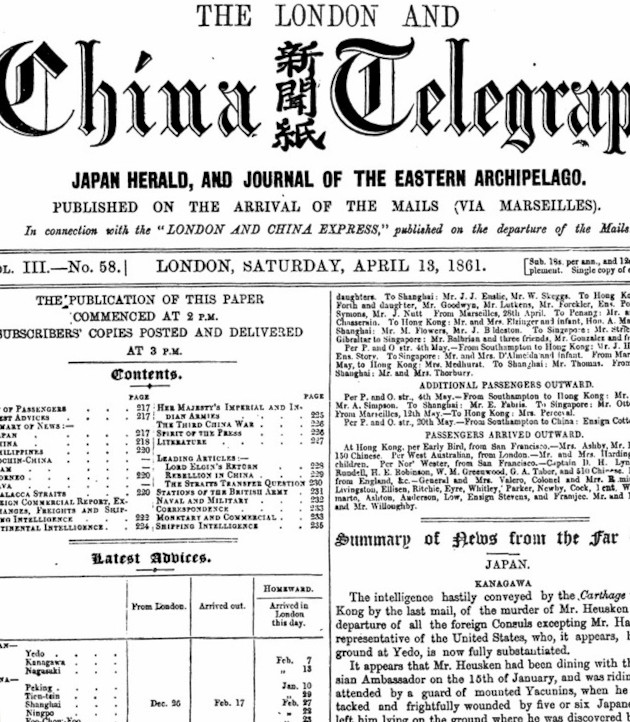
以下はチャイナ・メールが伝えるハリスが主張する「江戸残留」の論理。ニューヨークの時は新聞投稿で無料高校を設立する意味を世間に広く問いかけ「勝利」した。今度は江戸でヒュースケン暗殺以降の「各国公使たちとそこに同調する取り巻き」たちを相手に江戸に佇む意義を詳細に(長々しく)説く。ロンドンー中国テレグラフの記者にはハリスの説得に同調して記事を書いた感がうかがえる。13日の記事とは論調を変えて26日の記事はハリスの採った行動を世間に納得させる仕立てになっている。
| *以下、ロンドン・アンド・チャイナ・テレグラフ第3巻第59号・ロンドン・1861年4月26日(金)「極東からのニュース概要」の日本に関連する部分(ハリスが孤立無援で江戸にとどまった理由)を2026/07/22にg-翻訳で再翻訳。当該部分原文は訳文の後に掲載。 the London and China Telegraph:Japan herald,and Journal of the eastaern archipelago.published on the arraival of the mail (via Marseilles) Vol.Ⅲ-No.59. London, Friday.April 13,1861 |
|
the London and China Telegraph:Japan herald,and Journal of the eastaern archipelago.published on the arraival of the mail (via Marseilles) Vol.Ⅲ-No.59. London, Friday.April 26,1861 241p Summary of News from the Far East. JAPAN. The news from Japan is more favourable than might have been expected. Mr. Alcock and the other representatives who fled from Yedo have returned thither under assurances of protection from the Government. The following are among the conditions acceded to by the Court of Yedo :: "His Majesty the Tycoon to send a special letter of invitation to return. "The forts of Yedo to salute the French and English flags with twenty-one guns, which will be returned by the men-ofwar to the Japanese flag. "The Tycoon's body guard, the Ministry, and all the great Officers of State to receive the Envoys with becoming ceremony on landing. "An Embassy to proceed to Europe to acquaint itself with the power and civilization of those States Japan is in treaty with. "All obstructions to trade at the open ports to be swept away. "Custom-house espionage and squeezes to be abolished, and the posts erected for these purposes at Yokuhama to be demolished. "Consulate residences to be removed from Kanagawa, and sites for new ones to be selected on the 'location' called the Bluff,' the remainder then to be allocated to foreigners for private residences. "Consular offices henceforth to be at Yokuhama. "A delay of seven days was accorded for their consideration and acceptance, prior to the expiration of which a second interview took place, at which the Japanese Minister attempted unsuccessfully to obtain some modifications, but ended by frankly accepting everything in its integrity. Thus, after an absence from the capital of exactly five weeks, the Ministers returned to Yedo on the 2nd March." recal of our envoy is due in great measure to the de- According to the China Mail of the 16th ult., the cided position assumed by Mr. Harris, the American representative. It will be remembered that he alone remained at his post after the murder of Mr. Heusken, and his reply to the other foreign ministers on their requesting him to take joint action with them in the late demonstrations, shows how fully he understood the importance of his position. His firmness has, in all probability, been the means of securing our interest in Japan, which the tidings brought by the last mail appeared so fatally to threaten. Mr. Harris's official letter to Mr. Alcock, acknowledging the receipt of a compte-rendu of the Conferences held at Her Majesty's Legation in Yedo in January, is extremely able, and throws considerable light on the whole subject. Mr. Alcock requests the American Minister to sign a protocol, stating that the compterendu is a correct record of the Conferences referred to, to which Mr. Harris replies that, as he was not invited to assist at the meeting of the 21st January, and consequently was not present, he is unable to judge of the correctness of the report. He then sums up the conclusions to which Mr. Alcock and the other ministers arrived, viz. :- 'That no confidence can be placed in the good faith of the Japanese Government; that the members of the different Legations are exposed to assassinations by remaining in this -- ----------------- SHANGHAI. The Loudon mail of 10th Jan. arrived on 4th March by Here everything is remarkably quiet and in suspense until Messrs. Dent and Co.'s steamer, Ly-ee-moon. some judgment can be formed as to the advantages likely to accrue In a month to foreign trade in the market on the banks of the Yang-tzeor two these questions will probably be solved. By the latest kiang and in the northern ports still closed by ice. accounts the Expedition up the Great River had not proceeded beyond Nanking. Some communication had been held with the rebel chiefs who expressed a desire to conciliate the good will of foreigners and encourage trade. PROGRESS OF THE YANGTZE EXPEDITION. city; and that for the double purpose of securing personal with them. safety, and to produce a visible effect on this Government, it is advisable that the Legations should retire to Yokuhama,' and replies to them with considerable force and ability. His arguments are, to our thinking, irrefragable. He shows that it has ever been the desire of the Government that the foreigners should use the same precautionary measures adopted by the Japanese themselves, and asks whether it is just to require the Japanese to protect us with other appliances than those own security? Mr. Harris observes that the murder of Mr. Heusken was owing to his neglect of the warnings of the Government against his constant exposure of himself at night. A broad, sensible view is then taken of the conduct of the Government with respect to foreigners in past years, and of the difficulties occasioned by a change of policy. A barrier is suddenly removed, many men of high rank and political influence in Japan are violently opposed to the innovation, a spirit of hostility is aroused, and, however friendly may be the feelings of the Government, it is out of its power to control the fierce passions of the anti-foreign party. This reasoning appears obvious enough, and we do not well Mr. Harris then alludes to see how it can be answered. what he deems a great mistake into which the ministers fell at the Conference-a mistake which led to the still greater error of the flight from Yedo. Thus he writes :"It strikes me that all the arguments at the Conferences referred to are based upon the assumption that the Japanese Government represented a civilisation on a par with that of This is a grave error-the Japanese are the Western Powers. not a civilised but a semi-civilised people, and the condition of affairs in this country is quite analogous to that of Europe To demand, therefore, of the Jaduring the Middle Ages. panese Government the same observances, the same prompt administration of justice, as is found in civilised lands, is simply to demand an impossibility; and to hold that Government responsible for the isolated acts of private individuals I believe to be wholly unsustained by any international law. This principle is not acted on in the Western World. long ago a London jury exultingly acquitted a conspirator against the life of the Emperor of the French. I did not learn that the French Legation in London retired to Dover in consequence of this failure of justice. Again, in one of the greatest thoroughfares of Naples the French Minister was savagely assaulted at midday, and although hundreds of people witnessed this assault, the would-be assassins effected their escape, and to this day they have not been arrested. French Legation retire from Naples in consequence of the failure to arrest the criminals? In March last, the Regent of Japan was assassinated. Only a part of the murderers have thus far been arrested, and of those not one has been punished yet. This delay in effecting punishment on the assassins, of one so exalted in rank as the Regent, shows that the Japanese mode of procedure is different from that of the Western World. I desire to put on record my firm belief, that as long as I obthe precautions recommended by the Japanese Government, and used by the Japanese themselves, my residence To retire to Yokuhama in this city is a perfectly safe one. with the intention of producing an effect upon the Japanese Government, will, I think, prove a mistake. There was not one article in the American Treaty more difficult to obtain than the one securing a residence in Yedo of a diplomatic representative of the United States. The Japanese Ministers on that occasion warned me of the grave difficulties which a residence of Foreign Ministers was sure to create in Yedo, and they were very solicitious that I should accept a permanent residence in Kanagawa or Kawasaki, with the right of coming to Yedo whenever my duty required." -------------------- In conclusion Mr. Harris trusts that patience and forbearance may yet have the desired effect, and adds that he "would sooner see all the treaties with this country torn up, and Japan return to its old state of isolation, than witness the horrors of war inflicted on this peaceful people and happy land." We will not quarrel with Mr. Harris for the slight tinge of romance which leads him to describe Japan as "peaceful and happy." There are two sides to the picture, and for the moment he is glancing at that which is glowing in the sunshine. So be it, he has a right to look cheerfully on a land in which he has acted with such consistency, and if he over-cstimates the happiness of the people, he does not in the slightest degree exaggerate the importance of our retaining a friendly relation |
|
【上記の参考資料はネットで確認できます】 The London and China Telegraph /Japan Herald,and Journal of The Eastaern Archipelago. London Satueday,April 13, 1861 VolⅢ No.58 Frank Leslie's Illustrated Newspaper New York June 1,1861 No.289-Vol.XIL p38 |