ハリスには、ニューヨーク市で孤軍奮闘して、議会を敵に回して、貧しい子供たちの為に無料高校を建てた輝かしい「実績」があります。そのニューヨーク議会との闘いの中でハリスは新聞の投書欄を大いに活用しました。議場では十分な意見陳述ができない。すべての人々に話を聞いてもらえない。新聞の「投書」欄を借りて多くのニューヨーク市民に、無料高校建設を訴える自分が正しい、貧しい人々にも教育を授かる権利を与えよ、と匿名で―ハリスだとすぐにわかっちゃうんですけど―主張しました。ハリスはその戦術を再び選び、自由貿易を日本で展開するために(日本にはその時、新聞がなかった。仮名書の瓦版では枠が小さい)、ジャパン・ヘラルド紙を借りて英仏に「撤退論戦」を実名で挑んだのです。ハリスは日本の徳川現体制の温存をめざし、「ヒュースケン謀殺には彼自身に落ち度があった、日本政府(徳川幕府です)に責を負わせるのは間違いだ」と言い、その一方、英仏は現体制を揺さぶり自らに都合の良い日本新政権の樹立を画策してターミナルにある日本政府(徳川政権です)が悪いと糾弾します。
その現状を踏まえて日本外交を俯瞰するテレグラフの記者はハリスにロマンチストと言うレッテルを張ってお花畑の住人とあだ名しますが、それでも英仏とハリスの間に立って「割合公平な」論評をしているそぶりを見せています。実際、ハリスの論に傾倒しています。ロンドン・アンド・チャイナ・テレグラフは英国の新聞で東インド会社の役員が集まるコーンヒルにあります。経済実利一辺倒の場所、そこに立地して英国の富を膨らませる商業貿易を担っていますからアメリカのハリスとは敵同士なのですが、日本を開国させて貿易の利を生むという目的では仲間同士です。そして「儲かる」という視点からはハリスの手腕を見逃せません。ハリスの「自由と平等」という貿易手法は英国の商人にとっても、例えばハリスは通商条約に「最恵国待遇」を書き込んでいるようにみんなに「公平」なので、それゆえ尊重されるのです。
国を開くということは「自由貿易」をして「公平」にお互いが儲けることだとタウンゼント・ハリスは心底腹をくくっているから「自由貿易論」を心にしかと置いて日本でも自由と平等を叶えてみせると大見得きって、貿易のルールを説く指南書「万国公法」注1の理想と大義を込めて、下田にその交渉のためのアメリカ出先機関「公使館」を開きました。それをそのままに引っ張ってきて、自由と平等と公平の為に英仏の公使たちを相手に今、江戸市中で堂々たる論戦を張ったのです。
外交官がおたおた逃げ出すのか。江戸へ戻ってこい
英仏の公使たちはヒュースケン事件をきっかけにして公使館を江戸から神奈川に引き上げ、江戸の治安を守れない日本政府(徳川幕府です)を追い詰めようとします。そんなへっぴり腰の日本政府じゃ役に立たない、私達が代わりに江戸を治めてあげる。あんたらに大砲向けてドンパチやるよ、という英仏の脅しです。
ハリスはそんな英仏に正面から、いや、新聞紙の力を借りて側面からなのかな、「ロンドン-チャイナ新聞」紙上で英仏への対抗論をこう述べ立てます。
曰く、「私は英仏やプロシア、ロシアの公使たちが開いた”江戸から引き上げる会議”に呼ばれていないので”引き上げ賛成、反対”の意見を述べていません。いま、この誌上で私の意見を述べさせていただきます」
はて、それは。
あれ?これって、それ、ニューヨーク市で議会相手に学費無料高校建設に反対する保守派長老に立ち向かった時と同じ手じゃない?新聞紙面で読者を巻き込んで主張をさらす。ハリスの趣旨は初手から何も変わっていません。
「通商不可」の不備を改めるためにハリスが米国大統領委任公使として、アメリカ船の入港が認められた下田にやって来た。「古い日本は終わる。新しい日本が始まる」―それを戦争暴力ではなくて論旨の素手で成し遂げるのが私、タウンゼント・ハリス。英仏の戦争にまみれ汚れた公使たちが何ぼのもんだ。
以下はチャイナ・メール注2が伝えるハリスが主張する「江戸残留」の論理です。ニューヨークの時は新聞投稿で無料高校を設立する意味を世間に広く問いかけ「勝利」しました。今度は江戸でヒュースケン暗殺以降の「各国公使たちとそこに同調する(富の収奪に目のない)取り巻き」たちを相手に江戸に佇む意義を詳細に(長々しく)説きます。ロンドンー中国テレグラフの記者はハリスの説得をロマンティシズムとかわしながらもハリスに同調して記事を書いた感がうかがえます。ハリスの論が1860年代の、まさにその時代の世界的な=と言うことは西欧諸国に共通する=社会政治問題を取り上げて語られていたからです。13日の記事とは論調を変えて26日の記事はハリスの採った行動を日本国内の領事たちと、日本を相手に貿易を始めようとする「英語圏の世間」に納得させる仕立てになっています。
*以下、ロンドン・アンド・チャイナ・テレグラフ第3巻第59号・ロンドン・1861年4月26日(金)「極東からのニュース概要」の日本に関連する部分(ハリスが孤立無援で江戸にとどまった理由)を2026/07/22にg-翻訳で再翻訳。当該部分原文は訳文の後に掲載。
the London and China Telegraph:Japan herald,and Journal of the eastaern archipelago.published on the arraival of the mail (via Marseilles) Vol.Ⅲ-No.59. London, Friday.April 13,1861 |
「……彼ら自身の身の安全を確保し、かつ日本政府に対して目に見える効果をもたらすという二重の目的のために、各公使館は横浜へ引き揚げるのが賢明である」という主張に対し、彼は極めて説得力のある巧みな反論を展開しています。我々の考えでは、彼の論拠は論駁の余地がないほど正当なものです。彼は、日本人が自らの身を守るために講じているのと同様の予防策を外国人もとるべきだというのが政府の一貫した希望であったことを指摘し、日本人に対して、彼ら自身の安全確保に使っているものとは異なる手段で我々を保護するよう要求することが果たして公平と言えるのか、と問いかけています。ハリス氏は、ヒュースケン氏の殺害事件について、夜間に頻繁に外出することに対して政府が発していた警告を同氏が無視したことに起因するものだと述べています。続いて、過去数年間にわたる外国人に対する政府の対応や、政策変更によって生じた困難について、大局的かつ分別ある見解が示されています。すなわち、長年の障壁が突如として取り払われ、日本の高位高官や政治的影響力を持つ多くの人々がその変革に激しく反対し、敵対心が煽られた結果、政府がいかに友好的な感情を抱いていたとしても、攘夷派の激しい情念を制御することはもはや不可能であった、というのです。この論理は極めて明白であり、これに反論することは困難であると思われます。さらにハリス氏は、各国の公使たちが会議の席上で犯した重大な過ち――江戸からの退去という、さらに大きな誤りへとつながった過ち――についても言及しています。彼は次のように記している。「前述の会議におけるあらゆる議論は、日本政府が西洋列強と同等の文明を代表しているという前提に基づいているように思われる。これは重大な誤りである。日本人は文明化された国民ではなく、半文明的な国民であり、この国の情勢は中世ヨーロッパの状況と極めてよく似ている。したがって、文明国に見られるような慣行や迅速な司法の執行を日本政府に求めることは、単に不可能なことを要求するに等しい。また、個人の単独行動について政府の責任を問うことは、いかなる国際法によっても全く裏付けられていないと私は考える。西洋世界において、このような原則が適用されたことはない。かつてロンドンの陪審員団は、フランス皇帝の命を狙った陰謀者を意気揚々と無罪にしたことがある。この司法の不備の結果として、ロンドンのフランス公使館がドーバーへ引き揚げたという話は聞かなかった。また、ナポリの主要な通りで、真昼間にフランス公使が残忍な暴行を受けた際、何百人もの人々がその現場を目撃していたにもかかわらず、襲撃犯たちは逃亡に成功し、今日に至るまで逮捕されていない。犯人を逮捕できなかったことを理由に、フランス公使館がナポリから引き揚げただろうか?去る3月、日本の摂政が暗殺された。これまでに逮捕されたのは犯人グループの一部に過ぎず、そのうち一人として処罰を受けていない。摂政という極めて高位の人物の暗殺犯に対する処罰の遅れは、日本の手続き方法が西洋世界とは異なることを示している。私はここに、日本政府が推奨し、日本人自身も実践している予防策を講じている限り、この都市での私の居住は完全に安全であるという確信を記録しておきたい。日本政府に何らかの影響を与えるつもりで横浜へ引き揚げることは、誤りであると私は考える。米国外交代表の江戸での居住を確保する条項ほど、米国との条約において獲得が困難だったものはなかった。当時、日本の閣僚たちは、外国公使が江戸に居住することで生じるであろう重大な困難について私に警告し、職務上必要な折にはいつでも江戸へ赴く権利を伴って私が神奈川または川崎に恒久的な居住地を定めることを強く望んでいた」
--------------------(略)
結論として、ハリス氏は忍耐と寛容さがやがて望ましい結果をもたらすと信じており、次のように付け加えています。「この平和な国民と幸福な国に戦争の惨禍がもたらされるのを目にするくらいなら、むしろこの国とのあらゆる条約が破棄され、日本がかつての鎖国状態に戻る方がましだ」と。
日本を「平和で幸福」と評するハリス氏の言葉に、いささかロマンチックな感傷が混じっているからといって、我々は彼と論争し争うつもりはありません。物事には二つの側面があり、彼は今、陽光に照らされて輝いている側面を見ているに過ぎないのですから。それでよいのです。自ら一貫した行動をとってきたこの国に対し、彼が楽観的な眼差しを向ける権利はありますし、たとえ彼が国民の幸福を過大評価していたとしても、我々が友好関係を維持することの重要性を強調する点において、ハリスは決して誇張などしていないのです。
the London and China Telegraph:Japan herald,and Journal of the eastaern archipelago.published on the arraival of the mail (via Marseilles) Vol.Ⅲ-No.59. London, Friday.April 26,1861 241p Summary of News from the Far East.
JAPAN.
The news from Japan is more favourable than might have been expected. Mr. Alcock and the other representatives who fled from Yedo have returned thither under assurances of protection from the Government. The following are among the conditions acceded to by the Court of Yedo ::
"His Majesty the Tycoon to send a special letter of invitation to return.
"The forts of Yedo to salute the French and English flags with twenty-one guns, which will be returned by the men-ofwar to the Japanese flag.
"The Tycoon's body guard, the Ministry, and all the great Officers of State to receive the Envoys with becoming ceremony on landing.
"An Embassy to proceed to Europe to acquaint itself with the power and civilization of those States Japan is in treaty with. "All obstructions to trade at the open ports to be swept away.
"Custom-house espionage and squeezes to be abolished, and the posts erected for these purposes at Yokuhama to be demolished.
"Consulate residences to be removed from Kanagawa, and sites for new ones to be selected on the 'location' called the Bluff,' the remainder then to be
allocated to foreigners for private residences.
"Consular offices henceforth to be at Yokuhama.
"A delay of seven days was accorded for their consideration and acceptance, prior to the expiration of which a second interview took place, at which the Japanese Minister attempted unsuccessfully to obtain some modifications, but ended by frankly accepting everything in its integrity. Thus, after an absence from the capital of exactly five weeks, the Ministers returned to Yedo on the 2nd March."
recal of our envoy is due in great measure to the de- According to the China Mail of the 16th ult., the cided position assumed by Mr. Harris, the American representative. It will be remembered that he alone remained at his post after the murder of Mr. Heusken, and his reply to the other foreign ministers on their requesting him to take joint action with them in the late demonstrations, shows how fully he understood the importance of his position. His firmness has, in all probability, been the means of securing our interest in Japan, which the tidings brought by the last mail appeared so fatally to threaten. Mr. Harris's official letter to Mr. Alcock, acknowledging the receipt of a compte-rendu of the Conferences held at Her Majesty's Legation in Yedo in January, is extremely able, and throws considerable light on the whole subject. Mr. Alcock requests the American Minister to sign a protocol, stating that the compterendu is a correct record of the Conferences referred to, to which Mr. Harris replies that, as he was not invited to assist at the meeting of the 21st January, and consequently was not present, he is unable to judge of the correctness of the report. He then sums up the conclusions to which Mr. Alcock and the other ministers arrived, viz. :- 'That no confidence can be placed in the good faith of the Japanese Government; that the members of the different Legations are exposed to assassinations by remaining in this
-- -----------------
SHANGHAI.
The Loudon mail of 10th Jan. arrived on 4th March by Here everything is remarkably quiet and in suspense until Messrs. Dent and Co.'s steamer, Ly-ee-moon. some judgment can be formed as to the advantages likely to accrue In a month to foreign trade in the market on the banks of the Yang-tzeor two these questions will probably be solved. By the latest kiang and in the northern ports still closed by ice. accounts the Expedition up the Great River had not proceeded beyond Nanking. Some communication had been held with the rebel chiefs who expressed a desire to conciliate the good will of foreigners and encourage trade.
PROGRESS OF THE YANGTZE EXPEDITION.
city; and that for the double purpose of securing personal with them. safety, and to produce a visible effect on this Government, it is advisable that the Legations should retire to Yokuhama,' and replies to them with considerable force and ability. His arguments are, to our thinking, irrefragable. He shows that it has ever been the desire of the Government that the foreigners should use the same precautionary measures adopted by the Japanese themselves, and asks whether it is just to require the Japanese to protect us with other appliances than those own security? Mr. Harris observes that the murder of Mr. Heusken was owing to his neglect of the warnings of the Government against his constant exposure of himself at night. A broad, sensible view is then taken of the conduct of the Government with respect to foreigners in past years, and of the difficulties occasioned by a change of policy. A barrier is suddenly removed, many men of high rank and political influence in Japan are violently opposed to the innovation, a spirit of hostility is aroused, and, however friendly may be the feelings of the Government, it is out of its power to control the fierce passions of the anti-foreign party. This reasoning appears obvious enough, and we do not well Mr. Harris then alludes to see how it can be answered. what he deems a great mistake into which the ministers fell at the Conference-a mistake which led to the still greater error of the flight from Yedo. Thus he writes :"It strikes me that all the arguments at the Conferences referred to are based upon the assumption that the Japanese Government represented a civilisation on a par with that of This is a grave error-the Japanese are the Western Powers. not a civilised but a semi-civilised people, and the condition of affairs in this country is quite analogous to that of Europe To demand, therefore, of the Jaduring the Middle Ages. panese Government the same observances, the same prompt administration of justice, as is found in civilised lands, is simply to demand an impossibility; and to hold that Government responsible for the isolated acts of private individuals I believe to be wholly unsustained by any international law. This principle is not acted on in the Western World. long ago a London jury exultingly acquitted a conspirator against the life of the Emperor of the French. I did not learn that the French Legation in London retired to Dover in consequence of this failure of justice. Again, in one of the greatest thoroughfares of Naples the French Minister was savagely assaulted at midday, and although hundreds of people witnessed this assault, the would-be assassins effected their escape, and to this day they have not been arrested. French Legation retire from Naples in consequence of the failure to arrest the criminals? In March last, the Regent of Japan was assassinated. Only a part of the murderers have thus far been arrested, and of those not one has been punished yet. This delay in effecting punishment on the assassins, of one so exalted in rank as the Regent, shows that the Japanese mode of procedure is different from that of the Western World. I desire to put on record my firm belief, that as long as I obthe precautions recommended by the Japanese Government, and used by the Japanese themselves, my residence To retire to Yokuhama in this city is a perfectly safe one. with the intention of producing an effect upon the Japanese Government, will, I think, prove a mistake. There was not one article in the American Treaty more difficult to obtain than the one securing a residence in Yedo of a diplomatic representative of the United States. The Japanese Ministers on that occasion warned me of the grave difficulties which a residence of Foreign Ministers was sure to create in Yedo, and they were very solicitious that I should accept a permanent residence in Kanagawa or Kawasaki, with the right of coming to Yedo whenever my duty required."
--------------------
In conclusion Mr. Harris trusts that patience and forbearance may yet have the desired effect, and adds that he "would sooner see all the treaties with this country torn up, and Japan return to its old state of isolation, than witness the horrors of war inflicted on this peaceful people and happy land."
We will not quarrel with Mr. Harris for the slight tinge of romance which leads him to describe Japan as "peaceful and happy." There are two sides to the picture, and for the moment he is glancing at that which is glowing in the sunshine. So be it, he has a right to look cheerfully on a land in which he has acted with such consistency, and if he over-cstimates the happiness of the people, he does not in the slightest degree exaggerate the importance of our retaining a friendly relation
|
| |
注1 万国公法
ハリスは「万国公法」を引き合いに出して日本は「半文明国」なのだから我々「文明国」の価値判断をそのまま当てはめるべきではない、日本を指導する教育係として我々「文明国人」は寛容に動くべきだと主張します。「万国公法」が述べる「半文明国・日本」を大上段に置いて構える切り口は英国を即座に黙らせます。
エルギンは日本を「文明国」扱いして領主裁判権を一部放棄する通商条約を日本と結ぶという齟齬をやらかしていました。その上で尚且つ「万国公法」の領主裁判権を盾にとります。犯罪を犯した英国人を次々に無罪放免する英国領事のやり口が明らかになり日本側が「不平等だ」と不満を爆発させ痛烈な批判が「万国公法」へ向けて起こされます。
明治時代のジャーナリスト・詩人の小室屈山(こむろ くつざん)は「外交の歌」(明治15年1882/8月)を詠み、「万国公法という国際法があっても、いざとなれば弱肉強食が幅を利かせ腕力の強い国が勝つ。それが国際社会の掟だ。油断するな、国力を尽くせ」という厳しい現実をこう説きました。
西に英吉利(イギリス)北に露西亜(ロシア) 油断ななせぞ国の人 外表(うわべ)に結ぶ条約も 心の底は測られず 万国公法ありとても いざ事あらば腕力の 強弱肉を争ふ(弱肉強食)は覚悟の前のことなるぞ 嗚呼同胞の兄弟よ 御国に生れし甲斐あらば 尽せやはげめ 諸共にまごころ込めてつくすべし
「外交の歌」の五七調の詩にメロディが付けられて小学校唱歌にもなりました。ネットで探しても今この歌を聴くことはできませんけど、今また、先の敗戦のくさびを抜いて肌の傷が癒えた日本は今また、あの時の反省を忘れて雄大になろうとしています。
幕末から明治初期にかけて日本は西洋の国際法である「万国公法」を「普遍的な正義のルール」としていました。ハリスはその線に沿って「半文明国」日本を指導しました。しかし、実際には通商条約の治外法権・領主裁判権が不平等を日本に押し付け、正義のルール「万国公法」が「半文明国」の日本を守ってくれない現実を知らされます。
壬午事変1882が起きた直後、『東京横浜毎日新聞』や『時事新報』は、朝鮮半島で日本人が殺害されたこと、清国が大軍を動かして日本を圧倒したことに凄まじい怒りと危機感を煽る報道を続けました。「このままでは日本が清国やロシアに侵略される」という恐怖心が生まれました。ハリス流の弁論による解決など「お花畑のロマンティシズムにすぎない」として片付けられてゆきます。
「外交の歌」が広まるのも1882年(明治15年)8月。時事新報などが「清国と一戦交えるべし」「軍備を拡張せよ」と一斉に煽ったことに対し、『ジャパン・ヘラルド』は「日本のメディアはあまりにも過激で、大衆の復讐心や軍国主義的な感情を煽りすぎている」と冷静に論じました。
『ジャパン・メール』は、日本が「まごころ」と詠って軍備拡張へ向かうのは、「欧米列強が日本に不平等条約を押し付け、清国が軍事力で威圧してくるから」だと論じました。「外交の歌」が暗に軍備拡張を訴えるのは日本の独立を守るための「正当な」防衛本能だとし、欧米読者に対して「日本を追い詰めるべきではない」というメッセージを発信しました。
「戦争へ突き進む」流れに尽きます。「百巻の万国公法は数門の大砲に若かず,幾冊の和親条約は一筐の弾薬. に若かず。大砲弾薬は以て有る道理を主張するの備に非ずして無き道理を造るの器械なり」在野の論説・福沢諭吉
日本を『半文明国』として差別する欧米の公法論理など、額面通りに従う必要はない」という強烈な反発が言論界の主流となっていました。
外交の歌
西に英吉利(イギリス)北に魯西亜(ロシア)
油断な為(な)せそ国の人
外表(うわべ)に結ぶ条約も
心の底は測(はか)られず
万国公法ありとても
いざ事あらば腕力の
強弱肉を争うは
覚悟の前のことなるぞ
嗚呼同胞(ああどうほう)の兄弟(けいてい)よ
御国(みくに)に生れし甲斐あらば
尽せや励め諸共に
まごころ込めてつくすべし
注2 オルシーニ事件
オルシーニ事件(ナポレオン3世暗殺未遂事件)
イタリアの革命家フェリーチェ・オルシーニらが1858年1月14日、パリでフランス皇帝ナポレオン3世の馬車に3発の爆弾を投げ込み、多数の死傷者を出した暗殺未遂事件です。この暗殺計画の準備(爆弾の製造や資金調達)はロンドンで行われており、共犯者としてフランス人亡命者の医師サイモン・バーナードSimon Bernardがイギリスで逮捕・起訴されました。
フランス政府はイギリスに処罰を求めましたが、ロンドンの陪審員団は「フランスの帝政独裁に対する抵抗である」という弁護側の政治主張に賛同し、バーナードに無罪判決acquittedを下しました。ハリスは裁判結果を踏まえて「この領事裁判のごとき不法があっても、ロンドンのフランス公使館が判決に抗議してドーバーに退去したなんて話にはならない」とエルギンに皮肉たっぷりな当てつけを言っています。
注3 ナポリ事件
ナポリでのフランス公使襲撃事件
イタリア統一リソルジメントに揺れていた両シチリア王国の首都ナポリのトレド通りで、フランスの全権公使エドモント・ド・グロワーズ男爵が1858年11月6日の白昼、激しい襲撃を受けた事件。何百人もの市民が目撃していたにもかかわらず、犯人たちは見事に逃亡し、逮捕されませんでした。ハリスは「犯人を逮捕できなかったからといって、フランス公使館はナポリから退去しただろうか? いや、していない」と指摘します。
ハリスはこれら二件の事例を基に、エルギン卿英仏などの公使たちを非難しました。
「文明国であるヨーロッパのど真ん中でさえ、テロや暗殺未遂は起きるし、犯人が捕まらないことも、陪審員が犯人を無罪にしてしまうことだってある」「それなのに、彼らは本国へ逃げ帰ったり公使館を閉鎖したりはしなかった」「日本がまだ過渡期にあり、不逞浪士を完全にコントロールしきれていないからといって、事件が起きるたびに江戸を逃げ出して横浜に引きこもるのは、外交官としてあまりに適格性を欠く」
ハリスの徹底した「江戸残留」論は幕府から絶大な信頼を得るとともに、エリギン卿たち各国公使が「無様に」ひっそりと江戸へ戻る結果を導きました。
|


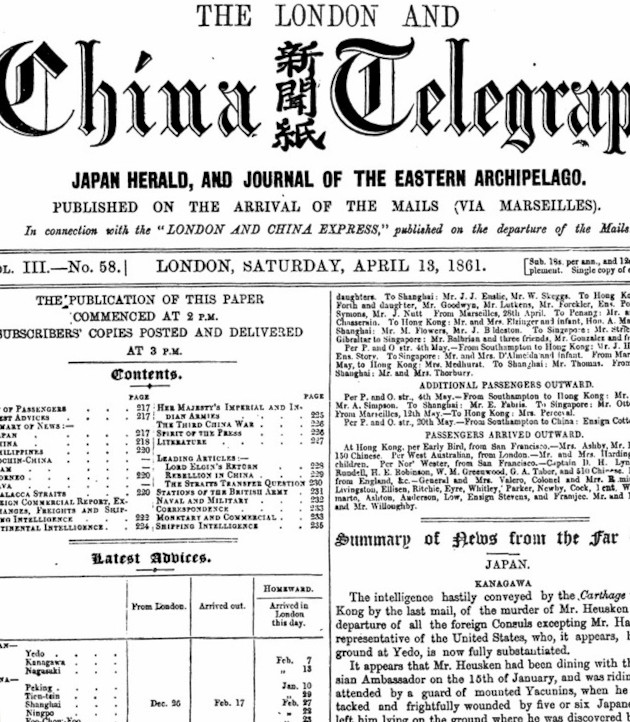 the London and China Telegraph:Japan herald,and Journal of the eastaern archipelago.published on the arraival of the mail (via Marseilles) Vol.Ⅲ-No.59. London, Friday.April 13,1861